FDOT Emergency Travel Alert: For information on the current situation, please visit the following
page -
FDOT Emergency Travel Alert: For information on the current situation, please visit the following
page - 

450334-1 SR 70 from CR 721 S to CR 599/128th Avenue
Project Details
| Work Type: | Widening |
|---|---|
| Phase: | PD&E |
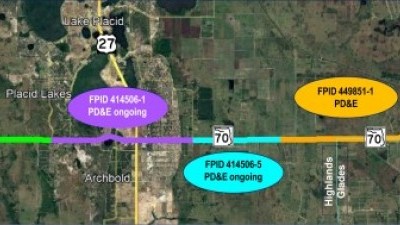
| Limits: | CR 721 S to CR 599/128th Avenue |
| Length: | 8.6 miles |
| County: | |
| Road: | |
| Study Cost: | $3,000,000 |
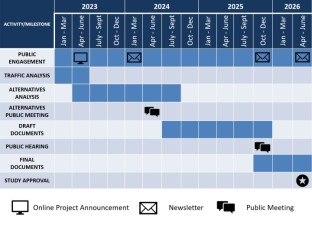
| Start of Current Phase: | Early 2023 |
| Est. Completion of Current Phase: | Mid 2026 |
About
On June 15, 2026, the Florida Department of Transportation (FDOT), pursuant to 23 U.S.C § 327 and a Memorandum of Understanding dated May 26, 2022, and executed by the Federal Highway Administration and FDOT, granted Location and Design Concept Acceptance for the S.R. 70 PD&E Study from C.R. 721 S to C.R. 599/128th Avenue.
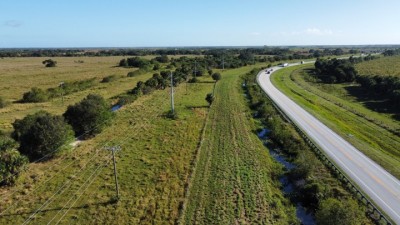
The improvements consist of widening S.R. 70 from the existing two-lane undivided roadway to a four-lane, divided roadway with paved shoulders, turn lanes, and a shared use path. The typical section includes two 12-foot travel lanes in each direction, a 40-foot grassed median and a 12-foot shared use path on the south (eastbound) side of the roadway.
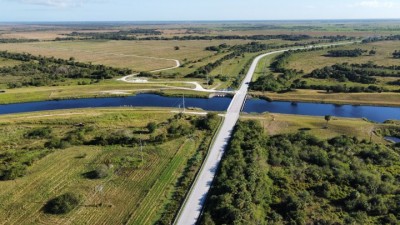
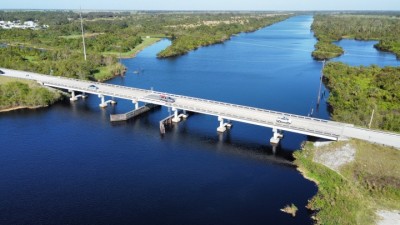
The existing two-lane Kissimmee River bridge is functionally obsolete and will be demolished. Two new bridge structures, one in each direction, will be constructed in its place. The S.R. 70 over Kissimmee River bridge typical section will include two 12-foot travel lanes in each direction and a 16-foot shared-use path on the eastbound side of the bridge. Additionally, the existing bridge over the Slough Ditch (C-41A) Canal that currently carries two lanes of traffic will be maintained and will carry westbound traffic in the future condition. A new two-lane bridge with two 12-foot travel lanes and a 16-foot shared-use path will be constructed on the south side of the existing bridge and will carry eastbound traffic.
The PD&E Study Phase of this project is now complete and the project will move to the next phase of development. Federal funding for subsequent project phases including design, right-of-way and construction is being pursued.
Public Involvement
FDOT held a public hearing for this project in-person (Indian River State College – Dixon Hendry Campus) on December 16, 2025 and online (through GoTo webinar) on December 18, 2025. Materials were also available for review and comment below from November 25, 2025 and comments for the hearing were accepted in multiple ways through December 31, 2025. To view what was presented at the hearing, see the Project Documents section below.
FDOT held a public workshop, with a live in person event on June 11, 2024 and a live online event on June 18, 2024. Materials were also available for review and comment below from June 4, 2024. And comments for the workshop were accepted in multiple ways through June 25, 2024. To view what was presented at the workshop, see the Project Documents section below.
FAQs
What is a PD&E Study?
A Project Development and Environment (PD&E) Study is a phase of the Florida Department of Transportation's (FDOT) project development process. A PD&E Study assists the FDOT in determining the location, conceptual design and social, economic and environmental effects of proposed roadway and other project improvements. The process follows procedures set forth in the National Environmental Policy Act of 1969 and federal and state laws and regulations. During the PD&E Study process, feasible alternatives are developed for improvement projects. These ‘Build’ alternatives are evaluated based on environmental, engineering and socioeconomic conditions, safety needs and public input. The need for additional right-of-way for improvements or stormwater will also be evaluated during the PD&E Study phase. The ‘No-Build’ alternative is evaluated throughout the study process. This ‘No-Build’ alternative leaves the existing transportation infrastructure as it is, with only routine maintenance as required for existing facilities. If the study results in a ‘Build’ alternative being selected, the project may proceed to the next phase, which is the design phase. The basic activities of a PD&E Study include:
Data Collection
The first major work effort is the collection of all available data pertaining to the study corridor including existing and planned infrastructure, existing and future land uses, drainage patterns, and environmental resources.
Alternatives Development and Analysis
Once data collection is completed, the Department develops and evaluates various alignment alternatives, including a ‘No-Build’ alternative. The ‘No-Build’ alternative assumes no improvements. The environmental impacts, social impacts and costs of these alternatives are quantified and summarized in an evaluation matrix.
Public Kickoff Meeting or Newsletter
A public kickoff meeting is held, or a newsletter is mailed, to introduce the project to the public and provide an opportunity to view and comment on the project’s need and objectives.
Alternatives Public Meeting
Combining the public input with the needs of the corridor, several improvement alternatives are developed and evaluated along with the “No-Build” alternative during the PD&E Study. This meeting presents the environmental and social impacts as well as estimated costs of the viable ‘Build’ alternatives as compared to the ‘No-Build’ alternative. The public is provided with an opportunity to view and comment on the alternatives under consideration.
Public Hearing
After all public comments are reviewed and the analysis of the alternatives has been refined, a formal public hearing is held to provide a forum for input from property owners and interested parties on the final recommendations. A final decision is not made until after the public hearing.
Final Acceptance
After the comments from the public hearing have been received, considered and addressed, the project reports will be finalized and submitted to the Office of Environmental Management for Location and Design Concept Acceptance. Once acceptance is granted, the PD&E Study phase of the project will be complete. The phases that follow the PD&E Study are design of the project, acquisition of right-of-way, if necessary, and construction of the improvements.